Table of Contents
Its roots are found in American literature, and its application in contemporary popular culture has brought it worldwide prominence.
Even though it’s been around for a while, it has come of age in modern speech, popping up in everything from movies to books to daily talks. The continuing attractiveness of colloquial terms and their capacity to convey the subtleties of human communication are called into doubt by their continued popularity.
Idioms are fascinating because they may convey complicated ideas in a condensed amount of words. “I’m your huckleberry meaning” is a fascinating example that begs investigation into how language changes over time and the cultural meanings associated with certain phrases.
I’m your huckleberry meaning
The origin of the term dates back to Mark Twain’s time in the late 19th century. Early examples of it in literature, especially in the writings of Mark Twain, provide light on its original use and meaning in context. Gaining insight into its historical origins allows one to see the language environment of the era.
Similar to several idioms, the meaning and application of “I’m your huckleberry” have changed as it has been used in various eras of American history. Examining these alterations suggests cultural modifications that may have impacted its development in addition to linguistic adaptations.
The phrase has been influential in a variety of literary and cultural contexts outside of Mark Twain’s writings. Analyzing examples of its use in other situations helps explain how idioms may leave their initial context and find their way into the larger cultural fabric.
The Relationship with Tombstone
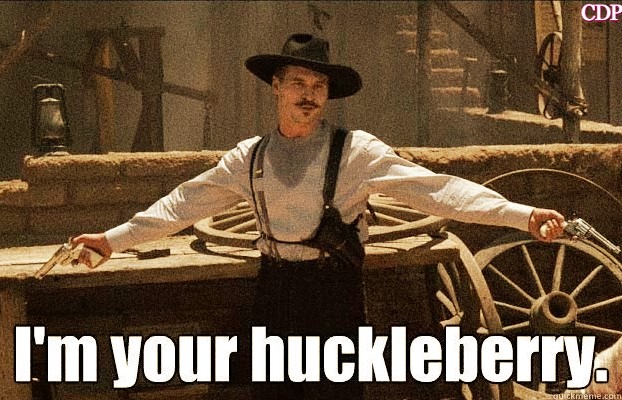
One reason it is so well-known is that it was used prominently in the 1993 movie “Tombstone.” The Old West-themed film popularised the expression and helped it come back into use in contemporary language.
The term gained widespread recognition due to its movie association, which also sparked fresh interest in its cultural and historical origins. The dynamic interaction between media and linguistic development is highlighted by the junction of cinema and language.
The famous remark is spoken by Val Kilmer’s character Doc Holliday in ‘Tombstone’, with a blend of charm and defiance. Examining Doc Holliday’s persona offers valuable perspectives on how fictional characters may influence the perception and acceptance of certain phrases, solidifying “I’m your huckleberry” as a part of popular culture.
Regional Differences
The phrase “I’m your huckleberry” may have various meanings in different places due to regional accents and cultural quirks. Examining these variations reveals how the sentence changes to fit various language contexts.
Idiomatic phrases’ meanings are often influenced by their cultural settings. Analysing how cultural quirks influence how it is understood in various contexts reveals the richness and adaptability of language.
Apart from geographical differences, the term has probably been interpreted differently throughout the world. Examining how it was received in different cultural contexts reveals how flexible and universal certain idioms are.
Definition of Idiomatic Expressions
Idioms, such as “I’m your huckleberry,” enrich language with connotations that go beyond its literal sense. The variety and depth that idioms provide to language expression become clear when one examines their function in communication.
Idioms are often used as linguistic shortcuts, condensing complicated concepts or feelings into a single phrase. Examining the importance of idioms in communication provides insight into how they support sophisticated and successful articulation.
When it is contrasted with comparable statements from other cultural contexts, it demonstrates how universally idiomatic terms are. Acknowledging these similarities highlights how language reflects the common human experience.
Analysis of Linguistics
It is possible to do a linguistic study of each word’s contribution to the overall meaning by dissecting the phrase into its constituent parts. The study gains depth by knowing the origins of the word “huckleberry” and how it has been used historically.
An understanding of it’s flexibility and variety may be gained by looking at how it works in other phrases. Contextual analysis reveals the minute details that contribute to the phrase’s unique meaning.
The phrase’s linguistic history across generations shows how language and communication patterns have changed, yet it has remained relevant. Gaining a deeper comprehension of language dynamics may be achieved by investigating its historical trajectory.
Well-known Sayings and Sources
Finding significant literary allusions to “I’m Your Huckleberry” demonstrates the poem’s ongoing influence in written works. Literary allusions give the phrase’s use a cultural and historical background.
Analyzing well-known quotations that include the term reveals its influence on language and audience resonance. The enduring impact of the term is partly attributed to these statements, which act as cultural markers.
The phrase’s frequent use in quotation marks demonstrates its influence on communication and language. By dissecting these examples, we may better understand the wider cultural ramifications of “I’m your huckleberry.”
Pop Culture and Social Media
Examining how it appears in memes, hashtags, and viral phenomena on social media shows us how deeply ingrained it is in modern pop culture. The term is now widely used in contemporary society due in part to these internet developments.
Language trends are widely disseminated via social media platforms. Examining the many internet adaptations and sharing of it highlights the dynamic interplay between language and digital culture.
Showcasing noteworthy examples of the phrase’s use on the internet demonstrates how adaptable it is to digital communication. These occurrences, whether in memes, tweets, or other online material, add to the continuous story of “I’m your huckleberry” in the digital era.
Conclusion
So, the statement “I’m your huckleberry” is a perfect example of the diversity of colloquial language; it has historical origins, has developed throughout time, and is given new life by cultural products like movies. Its timeless appeal is proof of the ability of language to convey complicated ideas in clear, unforgettable ways.
Continue your knowledge by reading more blog posts that are comparable to this one. You may easily get all the reliable information you want with just one click.